The Portfolio Pathway for Breast Radiologists
28 Aug, 2026




The numbers behind the pressure you already feel. Week one of our breast radiology series · August 2026.
Quick answerThe UK is now 32 per cent short of the consultant clinical radiologists it needs — more than 2,300 doctors — and breast imaging is among the scarcest expertise of all. The NHS spent £362 million in 2025 covering work it could not otherwise staff, screening volumes rose ten per cent in a single year, and nearly 941,000 scan results took more than a month to come back. If you are a breast radiologist weighing up your next post, every one of those numbers strengthens your hand.
Jump to section
There is a particular quiet that settles over a breast unit in August. Half the department is away, the lists are not, and somebody who was meant to have been replaced by now has still not been replaced. One learns to carry on. It is, after all, what the service has always done.
What the national picture offers is not a remedy but at least a consolation, which is the knowledge that your department is not peculiarly unlucky. It is simply typical.
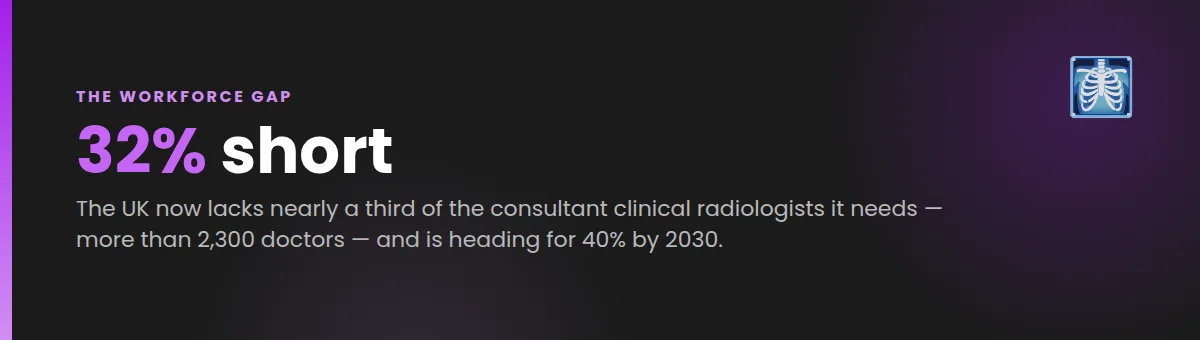
The Royal College of Radiologists published its 2025 clinical radiology census in early summer. The United Kingdom is now short of 32 per cent of the consultant clinical radiologists it requires, a gap of more than 2,300 whole time equivalent doctors, and on present course that reaches 40 per cent by 2030. Every clinical director of every radiology department in the country replied. This is not a sample of opinion. It is the service describing itself.
The previous year’s census had already picked out breast, along with chest, as an area where the want of specific expertise was most keenly felt. Breast imaging is not merely short of radiologists in the way that all of radiology is short of radiologists. It is short of people who can do a particular kind of work, learned slowly, which no reporting company can conjure up on a Friday afternoon.
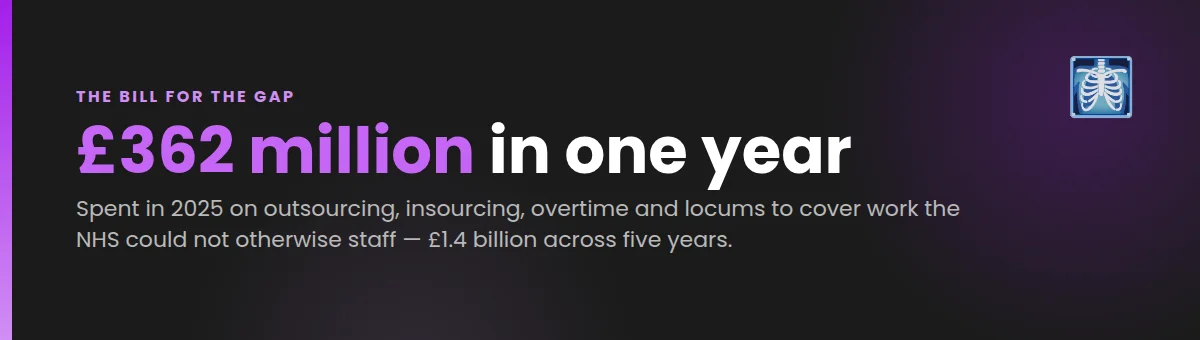
In 2025 the NHS spent £362 million on outsourcing, insourcing, paid overtime and locums, all of it to cover work it could not otherwise cover. Outsourcing by itself came to £241 million, a rise of 12 per cent on the year before. Across five years the bill has reached £1.4 billion, which is rather more than it would have cost to employ the consultants the service is missing.
It is worth pausing over that, because it disposes of the objection one hears most often. The money is not absent. It is merely being spent on something else.
The College has been plain about the consequences. Eighty-six per cent of radiology leaders doubt the quality of outsourced reports and 90 per cent say those reports must be checked again by their own people, which returns the work to precisely the team it was supposed to relieve. And for all that expenditure, nearly 941,000 scan results in England took longer than a month to come back in 2025.
In 2024/25 some 2.15 million women aged 45 and over were screened in England, a rise of just over 10 per cent in a single year. Among women aged 50 to 70, 1.94 million attended within six months of invitation, nearly 194,000 more than the year before. From that came 19,291 cancers detected, nine in every thousand women screened, an increase of almost 16 per cent.
These are good figures, and it does no harm to say so plainly. Thousands of women began treatment earlier than they otherwise would have, at the stage when treatment does the most good. They also represent more assessment clinics, more biopsies, more preparation for more meetings, and a great many more reads, delivered across 77 screening units in England ranging from a little over 5,300 women a year to more than 63,000.
There is further to go. Uptake stood at 70.6 per cent among women aged 50 to 71, against an achievable target of 80, and only 63.6 per cent of those invited for the first time attended, which is the best in a decade and still short of the 70 per cent minimum standard. Breast Cancer Now calculates that had the 80 per cent target been met in 2024/25, a further quarter of a million women would have been screened and some 2,228 more cancers found.
Should uptake improve, and considerable effort is going into seeing that it does, the reading burden rises again. It is a happy problem, but it is a problem, and it will land on the same shoulders.
For a doctor in a locum consultant post, a specialty doctor post or a clinical fellowship in breast radiology, all of this reduces to something rather simple. You are not an agreeable extra. You are the scarcest thing in the building.
That ought to alter what a post gives you in return. Screening sessions that count for something rather than sitting apologetically at the edge of the week. Supervision for the intervention you have already performed elsewhere. Time set aside for a portfolio pathway application. A contract long enough to take out a mortgage against. Every one of these is obtainable in the present market. Almost none of them appears in an advertisement, and fewer still are offered unbidden.
The 2025 census also revealed, for the first time, a geographic divide, with shortages worse in rural, deprived and under-resourced areas. Some trusts are in a far weaker position to appoint than others, and that governs what they will agree to. Knowing which is which is the difference between a post that keeps you steady and one that moves you on.
BDI Resourcing is a healthcare recruitment company, and breast radiology is our subject. We spend our weeks in conversation with breast radiologists and with the units attempting to appoint them. We know which trusts have been advertising the same post since the winter before last, which have screening capacity to offer, which will fund a fellowship year, and which are quietly rebuilding a service that came apart some time ago and would rather not discuss it. None of this is printed anywhere.
That knowledge is the entire point of us. A doctor applying alone sees whatever happens to be advertised this week. We see what is coming, what was never advertised at all, and where a clinical director is anxious enough to be generous about what the job might contain.
Then we do the part that is disagreeable to do on one’s own behalf. We go to the trust before you have so much as spoken to them, establish what the post genuinely involves and what the department is prepared to add to it, and find out whether the things you need are truly available. Where they are not, we say so and look elsewhere. Where they are, we see them written down before you accept, because a career in breast imaging is built out of what a job plan actually contains, one year after another.
Our doctors do not take the post that happened to be available. They take the post that was right, and generally on better terms than they would have been offered alone.
If you are between one post and the next, or merely curious what your breast experience is worth at present, speak to us first. It costs nothing and it entirely changes what you are choosing between.
Next week: how to move from a symptomatic service into screening, and what the reading standards really require.
The 2025 RCR census puts the shortfall at 32 per cent — more than 2,300 whole time equivalent consultants — rising to a forecast 40 per cent by 2030. Every clinical director in the country contributed, so the figure describes the whole service, not a sample.
The census singles out breast, alongside chest, as the expertise departments most struggle to find. Screening reads and breast intervention are learned slowly under supervision, which is precisely why the gap cannot be outsourced away.
£362 million in 2025 alone on outsourcing, insourcing, overtime and locums — £1.4 billion over five years, more than it would have cost to employ the missing consultants. Yet 90 per cent of departments re-check outsourced reports in-house.
Screening sessions that count, supervised intervention, time for a portfolio pathway application and a contract long enough to plan a life around. All of it is obtainable in the current market — but very little of it is advertised, and almost none is offered unprompted.
BDI Resourcing is an NHS Framework Supplier under the Workforce Alliance RM6333, Lot 2. We specialise in placing consultant and specialty grade radiologists into NHS trusts across the United Kingdom.