
Moving to Canada as a GP from the UK
03 Aug, 20268 Mins

Quick answerYou can move to Canada as a UK-trained GP and it’s one of the smoothest international moves you can make. Your MRCGP and CCT are formally recognised which means no further exams. Expect the whole process – from first application to seeing your first patient – to take around 6–12 months, cost you roughly £5,000–£8,000 in fees (before flights and moving) and land you gross earnings in the region of CAD $250,000–$400,000 a year (£145,000–£230,000). Canada is actively recruiting family doctors, your family can come with you on the same application and there’s a clear route to permanent residence.
Jump to section
Is Canada right for every UK trained GP?
I'll start by saying that an international move is a big consideration for you and your family. Canada is an incredible choice but you should weigh up the pros and cons before making a big decision. Here's what most doctors tell me:
The pros:
- No exams - registration is easy since UK training is recognised and MRCGP + CCT get's you licensed quickly and easily
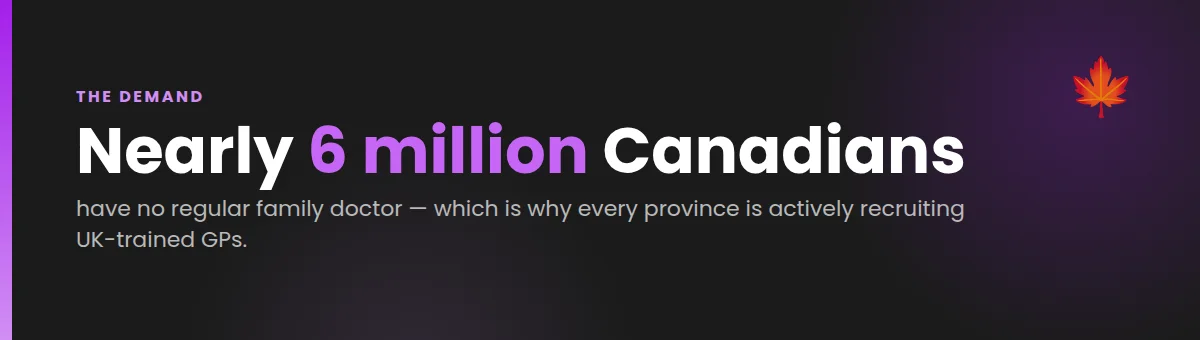
- Demand for GPs - Nearly 6 million Canadians don’t have a family doctor so there are plenty of options to suit every family
- Better earnings - If you're prepared to move then most UK GPs double their gross income with similar to lower costs of living
- Relocation Packages - If you can be flexible on location in Canada then many will add signing bonuses and relocation money on top
- Lifestyle - There's a real outdoor culture, good schools and work settings that allow flexibility and manageable workloads
- Familiar medicine - Canada has universal, publicly funded healthcare and the clinical job is similar to what you're doing now
The cons:
- Commitment - The move to Canada is well mapped out but it'll take 6 months+ with patience required
- Self Employment - Most GPs work for themselves which makes it a lucrative move but it means taking care of things like funding your own pension
- Distance - You need to be comfortable living a long haul flight away from the UK of course
- Winters - Depending on where you are, the winters are cold! That said, Summers are comparable to the UK in most places
- GP shortage - Canada has a big shortage of GPs and that’s why they want you - you have control over your patient list but expect high demand for your services
What qualifications do I need to work as a GP in Canada?
One of the key highlights of moving to Canada as a UK trained GP is that your training carries over for registration and licensing with no additional exams required. So long as you've come through the standard GP training route in the UK and completed MRCGP + CCT then you've already got a foot in the door.
The College of Family Physicians of Canada (CFPC) lists the UK as an 'approved jurisdiction' so a GP with CCT + MRCGP can get the Canadian family medicine qualification (CCFP) through “Certification Without Examination”.
The full requirements are:
- Your primary medical degree
- CCT in general practice + MRCGP
- GMC registration with recent GP practice
- A clean certificate of good standing
Everything gets verified through physiciansapply.ca (Canada’s central credential portal) first then you apply to the medical regulator of the province you’re heading to for your licence. Several provinces now grant UK GPs a licence without a supervision period.
For the step-by-step registration route, documents, costs and timelines, see our full guide to working as a GP in Canada.
How much do GPs earn in Canada?
We like to be conservative with earnings and everyone is different but the national average gross clinical payment to a family doctor is about CAD $324,000 a year (roughly £187,000). From that you typically pay 20–30% clinic overhead, leaving a pre-tax income of around CAD $230,000–$280,000 for a full-time GP - comfortably more than the UK equivalent and part-time or portfolio working scales accordingly. Rough guide by setting:
| Setting | Typical Gross Billings (CAD) |
| Urban clinic, standard list | $250,000–$320,000 |
| BC’s new LFP payment model (full time) | $300,000–$400,000 |
| Rural / underserved posts with incentives | $350,000+ plus bonuses |
Rural and smaller-town posts frequently add signing bonuses of around $20,000, relocation funding of $9,000–$15,000 and annual retention payments. Alberta also has stronger earnings and lower provincial taxes. Quebec pays the highest medians but requires French.
For a deeper dive into pay structures, cost of living and how to negotiate the best package, read our full guide to how much GPs earn in Canada.

How long does it take to move to Canada?
An international move isn't a quick one and we suggest allowing 6-12 months from decision to landing. Typically credential verification through physiciansapply.ca and CFPC certification take up to 3 months (running in parallel) then applying for jobs, getting your provincial licence and visas add another 2-3 months. If you're organised it's possible to make it happen quickly but it's better to be prepared for some parts to take time and some of the administrative waiting will be out of your hands.

How much does it cost to move to Canada as a GP?
We recommend budgeting £5,000–£8,000 (roughly CAD $9,000–$14,000) in fees for professional registration and immigration. These are the major expenses you'll come across:
- Credential verification (physiciansapply.ca) - ~$1,000 across your documents
- CFPC certification - $533 application + $3,518 certification fee
- Provincial licence application and first-year registration - ~$2,000–$3,000
- Work permits and biometrics for the family - a few hundred dollars per person
- Medical indemnity (CMPA) - much cheaper than UK indemnity and often reimbursed by the province
On top of that you'll need to account for flights, shipping and a rental deposit which could be another £5,000–£10,000 depending on how big your family is. The good news is that many employers will reimburse these expenses through relocation packages, especially outside the big cities.
We've helped more than 3,000 doctors make international moves and no two moves are ever the same - if you want some specific advice on your situation then feel free to ask us a question and we'll be happy to help.
Will I be able to get a visa for me and my family?
Doctors are on Canada’s priority list for visas and your job offer will qualify you and your family for an LMIA-exempt work permit (basically meaning your employer doesn’t have to prove no Canadian could do the job) with priority processing for physicians. Your spouse will get an open work permit so they can work for any employer too and your children can join you with free schooling just as they get in the UK.
There's also Express Entry for GPs meaning you qualify for permanent residence within a couple of years and once you have that eligibility for citizenship comes after three years if you want it.
Are there plenty of job opportunities for GPs in Canada?
Around one in five Canadians - nearly six million people - has no regular family doctor and every province is currently recruiting internationally. UK-trained GPs are in greatest demand since your CCT pathway is already recognised for licensing and family medicine is very similar in Canada to primary care in the NHS.
The greatest demand is for traditional family practice jobs however walk-in and urgent care, hospitalist work or blended roles are all possible. Part-time and flexible arrangements are generally easy to negotiate because clinics need whatever hours you can offer.
For where to search, who to register with and what to check before signing, see our guide to GP jobs in Canada.
Where might I end up working?
- British Columbia - an active recruiter of UK GPs right now. The new LFP payment model has transformed family practice pay and BC grants UK GPs a full licence without supervision. Vancouver is expensive where as Vancouver Island and the interior are the sweet spot.
- Ontario - they have the biggest job market by far from Toronto to small-town practices a couple of hours out.
- Alberta - they have highest take-home once tax is factored in with Calgary and Edmonton offering big-city life at half the property cost of Vancouver.
- Nova Scotia and Atlantic Canada - they have aggressive incentive packages, gentler pace and the closest flight home to the UK.
The general rule is that the further you go from downtown Toronto or Vancouver, the more you earn and the more they’ll pay to get you there. A mid-sized town of 20,000–100,000 people is where most UK GPs find the best balance of income, lifestyle and amenities.
Is it worth moving to Canada as a UK trained GP? A summary
For most UK GPs weighing it up the answer is resoundingly, yes. You’re in the rare position of holding a qualification Canada accepts without exams, in a profession Canada is desperate to recruit and with a visa system built to fast-track you and your family. The realistic deal is 6–12 months of admin and around £10,000–£15,000 of upfront costs (much of it often reimbursed) in exchange for roughly double the gross income, more clinical autonomy and a lifestyle upgrade - balanced against distance from home, colder winters and swapping the NHS safety net for running your own billing. If the pull of family in the UK is manageable and you’re comfortable with a bit of paperwork it’s one of the best-value moves in medicine right now. Start the credential verification early, pick your province before you pick your job and the rest tends to fall into place.
FAQs
Do UK trained GPs need to sit exams to work in Canada?
No. MRCGP holders qualify for the Canadian family medicine qualification (CCFP) through the CFPC’s Certification Without Examination route.
How long does the move to Canada take?
Allow 6–12 months from starting your paperwork to seeing your first patient. Credential verification is the slowest step so start it first.
How much does it cost to move to Canada as a GP?
Around £5,000–£8,000 in professional and immigration fees heading up to between £10,000–£15,000 all-in with flights and shipping. Much of it is often reimbursed by employers.
How much do GPs earn in Canada?
Gross billings of roughly CAD $250,000–$400,000 a year which nets around $230,000–$280,000 before tax after clinic overheads.
Can I bring my family to Canada?
Yes. Your spouse or partner receives an open work permit and your children attend state schools free. Permanent residence is a realistic goal within a couple of years.
Which Canadian province is best for UK GPs?
BC recruits UK GPs hardest and pays well under its LFP model. Ontario has the most jobs. Alberta offers the best take-home pay. Atlantic Canada offers the biggest incentives.
Sources
- Certification From Outside Canada — College of Family Physicians of Canada
- physiciansapply.ca — Medical Council of Canada
- Physicians in Canada — Canadian Institute for Health Information
- Family Open Work Permits — Government of Canada (IRCC)
- Express Entry — Government of Canada (IRCC)
- LFP Payment Model — Government of British Columbia
- Provisional Registration (IMGs) — College of Physicians and Surgeons of BC
- General Medical Council — GMC (UK)
Thinking about moving to Canada?
Moving to Canada is a big step for any GP. It's a career move but also a big life change too. If you want to know more about the registration process, what it's like moving overseas, life and work in Canada, how much you'll actually earn, visa processes or anything that's playing on your mind then let me know. I've helped thousands of doctors make international moves so I understand how big a commitment it is and all of the steps along the way. Drop me a message and I'll get back to you or we can arrange a call.
Equally if you're ready to make the move then take a look over some of our live jobs – if you're looking for something specific I can connect you with hundreds of independent clinics as well as all of the major corporates who are consistently hiring.